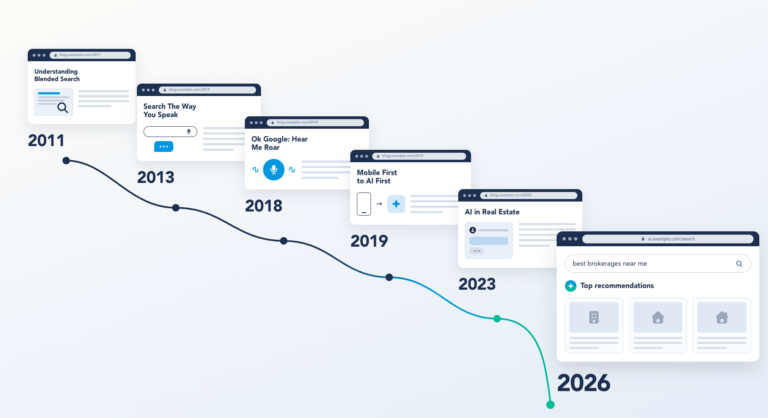


At the T3 Sixty Leadership Summit in Miami in 2018, Stefan Swanapoel shared a concept that’s stuck with me ever since. He talked about how technology and the real estate world was changing “gradually, then suddenly.”
Hemingway’s line, by way of Swanepoel, by way of me, in a blog post I wrote that May.
Eight years later, it’s still the most accurate description I have of how the real estate actually changes. At it is especially true right now with AI search reshaping how buyers and sellers find brokerages.
We published a blog last week looking back on fifteen years of Union Street Media writing about AI in real estate. We looked back on the predictions we made about machine learning, voice search, natural-language search, and the AI-first future. They were generous about the ones we got right. They were honest about the one I got pretty wrong. That’s fine. Predicting the future is mostly the work of being directionally right and specifically wrong.
What I keep coming back to isn’t the predictions. It’s the quote.
Gradually, then suddenly.
The gradual part is where the real work happens. Years of writing content, building site structure, earning authority, choosing the right partners, doing the unglamorous SEO and GEO (Generative Engine Optimization, the new discipline of getting recommended by AI engines) work that nobody notices. None of it generates a press release. None of it goes viral. It just compounds.
And here’s the part I want to be specific about, because it matters right now.
64% of our clients have been with us for four years or more. That’s not a marketing number. It’s the operating reality of our business. The brokerages who’ve been on our platform the longest aren’t getting a different platform than newer clients. They’re getting a longer compounding curve on the same one.
Their content is deeper. Their authority is older. Their structured data has been working harder for longer. Their site has been answering the right real estate questions in their market across multiple algorithm shifts, multiple platform changes, and now multiple shifts in how AI engines read the web. When AI search arrived, they weren’t scrambling. They were already where they needed to be, because we’d been hardening the platform underneath them the entire time.
That’s the part of our business model that doesn’t fit on a feature comparison chart. We’ve spent 27 years building a platform that gets stronger the longer a client grows on it. The SEO foundations we laid way back when we first started became the GEO foundations we needed in 2024. The content structures we built for Google’s algorithm updates became the content structures AI engines now use to recommend brokerages. The integrations, the data architecture, the page types, the optimization work — all of it compounds.
Our clients didn’t just buy a real estate website from us. They bought into a platform that’s been getting hardened, refined, and extended for more than two decades. The work they did with us five years ago is doing work for them today that they don’t have to think about. That’s the bet we’ve been asking brokerages to make since 1999, and that’s the bet that’s paying off in the AI search era.
Then the “suddenly” arrives.
New technology. A regulatory change. A consumer behavior shift that’s been building for a decade and crosses some invisible line where it becomes the default overnight. AI search is one of those moments. ChatGPT, Gemini, Perplexity, and Google’s AI overviews all started recommending brokerages to consumers, and the brokerages that did the gradual work on a platform that compounds are ready. The ones that didn’t are trying to build five years of foundation in five months on whatever stack they happen to be on.
The race wasn’t decided in the moment everyone was watching. It was decided in the years no one was.
Now here’s what I don’t want anyone to miss.
If you’re a brokerage owner reading this and you’re worried the gradual work happened without you, I want to be clear: it is absolutely not too late to start. Compounding doesn’t have a cutoff date. The clients who started with us in 2020 are five years into their compounding curve right now, and they have a foundation today that brokerages who started in 2015 took ten years to build, because the platform got hardened in the meantime. The earlier you start, the more the platform does for you. But starting today is dramatically better than starting in two years, and starting in two years is still better than not starting at all.
The brokerages winning today are the ones who did the gradual work on a platform that compounds. The brokerages winning two years from now are the ones who start that compounding curve today.
If you want to see the full record on what we’ve been writing about AI in real estate, the blog post is here.
If you want to talk about getting on the curve, reach out!
Gradually, then suddenly. That’s how real estate changes. That’s how it’s always changed. The only question is whether you’re on a platform that compounds with you, or one that resets every time the world shifts.