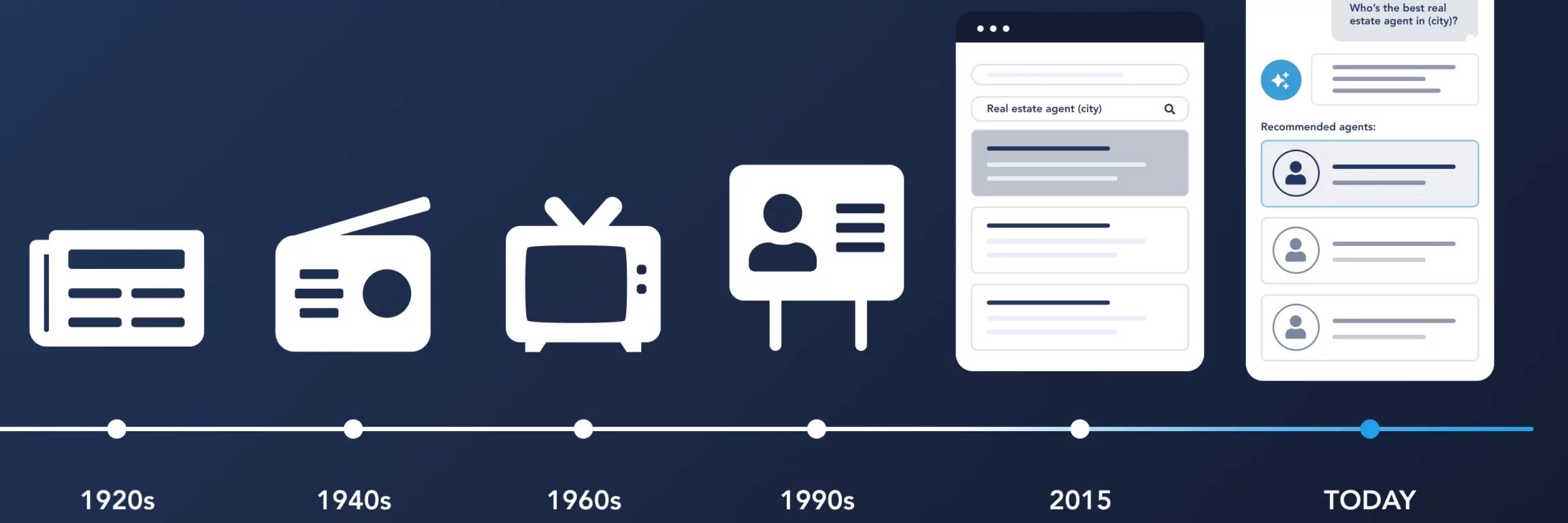

“I want to show up in AI” is the new “people need to know my name.”
For a decade, brand awareness was the marketing discipline that couldn’t defend itself in a budget meeting.
Attribution won. Lead gen won. Every marketing dollar had to trace back to a form fill, a demo request, a closed deal. The tools got better, the data got cleaner, and we all got very good at answering the question “what did this ad produce?” with a number. The marketers who thrived were the ones who could show the math. The ones who kept saying “brand matters” without a spreadsheet got quietly moved to a smaller table.
Then AI search happened.
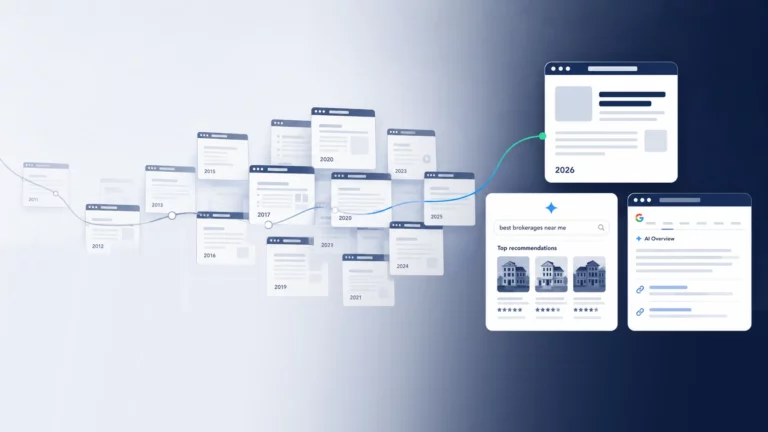
Suddenly, the industry that spent ten years building perfect attribution frameworks is looking at a new channel where none of them work. ChatGPT doesn’t send referral traffic with a UTM. Gemini doesn’t hand you an analytics event. Perplexity doesn’t tell you who saw its recommendation of your brokerage or why. Google’s AI overviews sit above the organic results and answer the question before the click ever happens.
The measurement layer we built our entire discipline on is quietly breaking down. And into that gap is walking a discipline everyone deprioritized: brand awareness.
Only nobody’s calling it that.
They’re calling it “showing up in AI.” They’re calling it “getting cited by ChatGPT.” They’re calling it “GEO strategy.” They’re calling it a lot of things that sound new, technical, and futuristic, but strip the vocabulary away and what they’re describing is the oldest game in marketing.
They want to be known.
What actually changed
I want to be careful here, because “brand awareness always mattered” is a lazy version of this argument. The interesting version is why brand awareness is coming back now, specifically.
Four things happened at once.
Attribution started decaying. iOS privacy changes, cookie deprecation, and consent frameworks made it harder to trace a lead back to a first touch. Every marketer will tell you the numbers in their attribution dashboards don’t tie out the way they used to.
AI search arrived and skipped the measurement layer entirely. Not “we haven’t figured out the tracking yet.” There is no click. There is no session. There is no attribution to build.
Zero-click search took over Google. AI overviews, featured snippets, and knowledge panels answer questions without sending traffic anywhere. If you’re not the source being cited in the answer, the click never happens.
Sales cycles got longer. By the time someone reaches out to you, they’ve already spent weeks or months reading, watching, asking around, and quietly making up their mind. They know who you are. They know who your competitors are. They’ve mostly decided. Whatever influenced those decisions happened somewhere you couldn’t see, in the space between the ad they didn’t click and the form they finally filled out.
All four of these forces do the same thing: they take marketing influence and move it upstream, out of the measurable moment and into the ambient zone. The zone we used to call brand awareness.
The real estate window
Here’s the caveat worth spending a paragraph on, especially if you’re in real estate.
The shift I’m describing hasn’t hit every industry evenly. In some verticals, AI Overviews have already taken over. BrightEdge, which has tracked nine industries continuously since February 2025, put healthcare at 88% AI Overview coverage and B2B tech at 82% as of February 2026. Real estate looks nothing like that. Depending on whose dataset you use, somewhere between 4% and 6% of real estate queries currently return an AI Overview, the lowest rate of any major consumer vertical. My read on why: Google has spent years building property search features that already work, including local packs, map results, and dedicated housing modules, and it has less reason to summarize a question it can already answer with an interface.
But low is not the same as stable. Across all tracked queries, AI Overview presence climbed from roughly 30% to 48% over those same twelve months, and the verticals Google held back the longest have tended to move fastest once it decided to move them. Real estate is already seeing the edge of it. In December 2025, a Google data partner began surfacing home listings, complete with price, photos, and a “Request a tour” button, directly in mobile search results. Zillow’s stock dropped more than 8% in a single day, taking CoStar and Realtor.com down with it. The market read that experiment as a preview of where property search is heading. It was right to.
Translation: real estate brokerages are looking at a window that most other industries have already closed. The zero-click future is coming for real estate too. But there’s still meaningful runway right now to build the brand foundation that will decide who gets recommended when it arrives.
That runway is what makes the argument I’m about to make actually actionable, and not just retroactive advice.
The pushback
The reasonable skeptic reading this is going to push back with “you’re just defending unmeasurable work.”
That’s fair. It’s also not the whole story.
Brand awareness is not a permission slip to stop measuring. It’s a recognition that the frameworks we built for the last decade were always incomplete, and AI search made that incompleteness impossible to ignore. Trust-based marketing doesn’t mean unmeasured marketing. It means measuring different things.
Share of voice. Unaided brand recall. Direct traffic. Branded search volume. Mention counts across the publications and platforms AI engines read. Citation rates in AI-generated answers. Content velocity and depth against competitors. These are all measurable. They just weren’t the things we chose to measure when the lead-gen dashboard was the whole game.
The smart marketers I’m watching right now aren’t abandoning lead-gen measurement. They’re adding brand measurement back in. They’re rebuilding the layer their predecessors dismantled during the attribution decade, because they can see that the questions AI search is going to force them to answer — did we get cited, did we get named, do we own our category — are questions the old lead-gen dashboard was never going to answer.
The redemption arc
Here’s the part I actually think is interesting.
The brokerages I see getting recommended by AI engines right now are the ones who spent five years being known in their market. They didn’t optimize for AI. They optimized for being the answer. AI just started noticing.
The publications getting cited in AI-generated responses are the ones who invested in depth, authority, and longevity over years — the same publications lead-gen marketers dismissed as “top of funnel” and refused to spend against.
The industries where AI search is reshuffling the winners are the ones where a handful of players built real brand equity while everyone else was optimizing conversion rates on landing pages.
The underdog is back. Not because it changed. Because the game finally started rewarding it again.
What this means right now
If you’re building a marketing plan for 2026, I’d tell you this. Every hour you’re spending trying to figure out “how to optimize for AI search” is an hour better spent asking a harder question: is my brand actually strong enough that AI engines have a reason to recommend it?
Because that’s what AI search rewards. Clever prompting helps. Schema markup helps. Working with someone who knows the technical side of GEO helps. All of that is real work that moves the needle. But it’s the last layer of a stack, not the first one. And if the foundation underneath is thin, the tactical work has less to compound on. The brokerage with fifteen years of content depth and market authority is going to out-cite the one with a perfectly optimized schema and a six-month-old blog every time.
This is the part that feels vindicating, if I’m being honest. The SEO work we’ve been doing for years has always been the kind that holds up in a moment like this. No black hat tricks. No shortcuts. No manipulation-of-the-week tactics that work until Google patches them out. Just genuinely useful content, structured well, published consistently, aimed at answering real questions the people we serve are actually asking. It turns out the SEO work you can defend to the reader is also the SEO work AI engines learned to trust. We didn’t change our approach when AI search arrived. We didn’t need to. The discipline that was right for humans is the same discipline that’s right for the engines reading on their behalf.
Invest in being known. Publish depth. Get cited by publications your audience actually reads. Build the kind of content library that answers questions people are asking in the way they’re asking them. Say something consistent across every surface. Show up in the places your industry already trusts, even when you can’t attribute a lead to it.
None of that is new advice. It’s just old advice wearing an AI-shaped costume.
The marketers who never stopped doing it are the ones AI is quietly rewarding right now.
The rest of us are catching up.