
If you’ve been reading our blog for a while, you already know we’ve been writing about AI in real estate for a long time.
So, we dove into the archive and found fifteen years of posts about artificial intelligence, machine learning, voice search, natural-language search, and conversational marketing. Some predictions landed on schedule. One landed twelve years early. A few were wrong about the mechanism but right about the direction.
Here’s what we found:
2011-2014: when AI was still a hypothetical
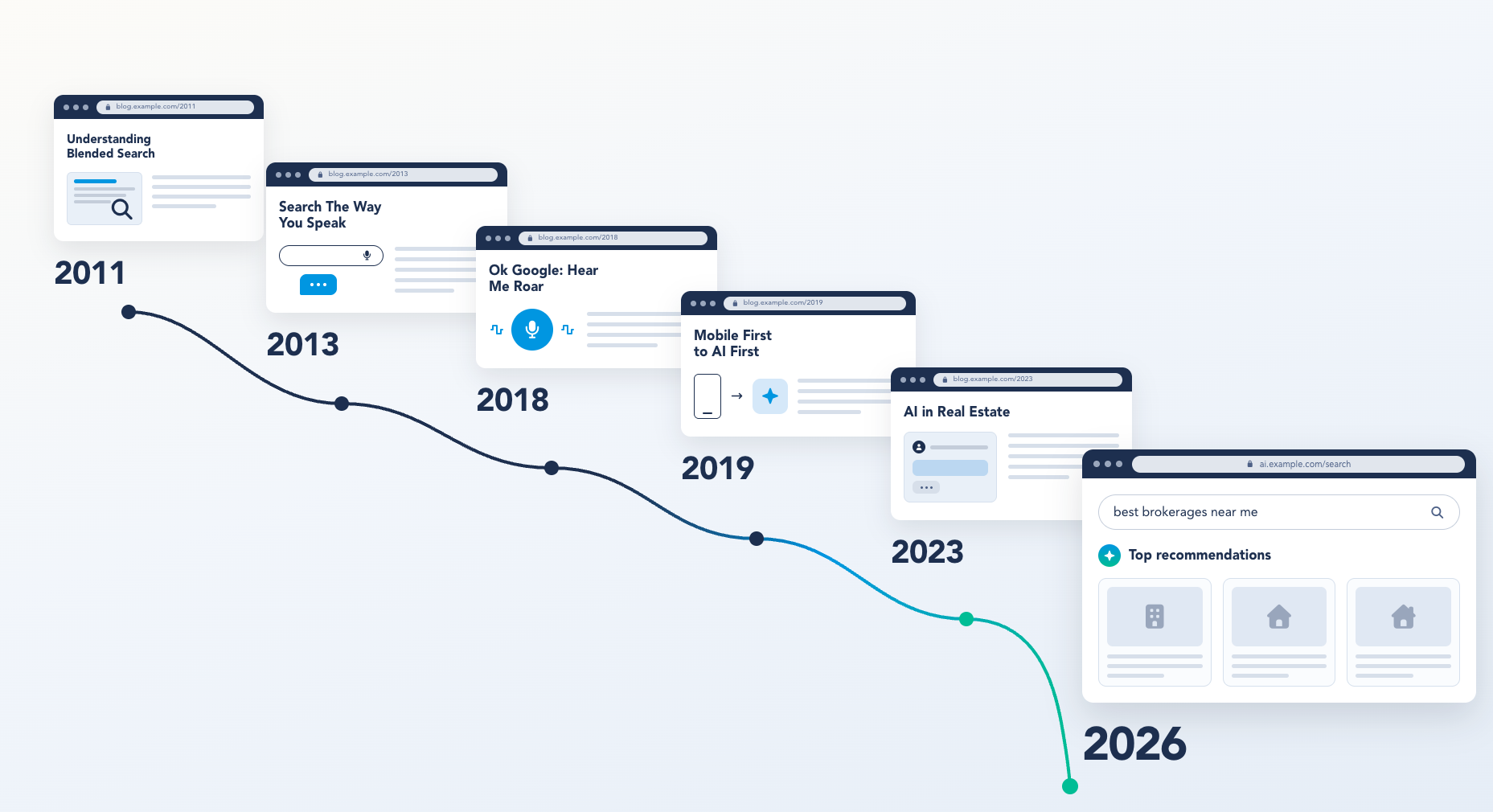
The earliest mention of artificial intelligence in our archive is from December 2011, in a post called Searching With My Good Eye Open:
“It may take an Einstein however, to make the next break through such as voice recognition and artificial intelligence on a mass scale. Whatever is next, it will still have to serve the core mission of search engines, which is to deliver accurate, high quality results.”
— Union Street Media blog, December 2011
Fourteen years ago. The “Einstein” part turned out to be a transformer architecture and a lot of GPUs, but the underlying point held up.
Two years later, in July 2013, we published Natural Language: Search The Way You Speak. This one didn’t predict anything. It announced a shipped feature:
“A home on at least 2 acres with a garden.”
“A Victorian lakefront home with a porch.”
Phrases like these are the natural language of real estate. They’re the way people talk about the properties they want. Search engines like Google and Bing understood this long ago, and now when you visit them, you’re given a single text input into which you type your search. We’ve leveraged our deep understanding of real estate data to make it possible for users to search for properties on your site using this familiar method.
— Union Street Media blog, July 2013
We built natural-language property search in 2013. ChatGPT launched in November 2022. We were nine years ahead of the cultural moment that made conversational search obvious to everyone.
2018-2019: the AI-first prediction
In May 2018, Ted Adler wrote Ok Google: Hear me Roar while dictating it into his phone, which was the point:
“Here comes voice search. In fact, it’s actually been here for a while. As Stefan Swanepoel said at the T3 Summit that I attended this spring in Miami, voice search is a great example of how the world is changing ‘gradually, then suddenly.'”
— Union Street Media blog, May 2018
Gradually, then suddenly is the most accurate description of how AI in real estate actually unfolded.
A year later, we published the post that aged best. Moving from a Mobile First to an AI First World cited Google CEO Sundar Pichai’s 2016 prediction that the next ten years would be AI-first, then made its own:
“A truly AI-first world may still be 3-5 years away… agents will be able to focus solely on creating connections as top of funnel lead generation and middle of funnel lead qualification and nurturing become AI-driven.”
— Union Street Media blog, June 2019
Three to five years from June 2019 lands between June 2022 and June 2024. ChatGPT launched in November 2022. Google rolled out AI Overviews in May 2024.
What we got wrong: voice
Not every prediction landed. In January 2019, we wrote:
“At Union Street Media, we are confident that more than half of all searches will be voice activated in the next three years.”
— Union Street Media blog, January 2019
That isn’t how it went.
The underlying claim wasn’t really “people will talk to Alexa about real estate.” It was deeper: people will search by asking, in full sentences, the way they actually talk. That part became overwhelmingly true. It just happened through chat, not voice. The mechanism was wrong, but the behavior shift was right.
This is what gradually, then suddenly means. The gradual part had been building since at least 2011. The sudden part wasn’t a single new technology; it was the moment a critical mass of consumers decided typing full questions into an AI was normal.
2020-2023: the chat bridge
In August 2021, we published What is Conversational Marketing for Real Estate?, citing a research forecast that 70% of white-collar workers would interact with conversational platforms daily by 2022. Fifteen months later, ChatGPT launched, and the forecast looked conservative.
In April 2023, What is AI and How is it Used in Real Estate? captured the moment everyone else caught up:
“It seems like overnight ‘AI’ has been everywhere! Looking at the graph from Google Trends… around July 2022 is when interest really began to peak.”
— Union Street Media blog, April 2023
A month later, Intelligence and Artificial Intelligence for Real Estate planted the flag that became our durable stance:
“Artificial Intelligence is an amazing tool, but tools don’t build things unless someone wields them.”
— Union Street Media blog, May 2023
That’s the human-in-the-loop argument we still make today. It’s not a hedge, it’s a claim about what AI is good at and what it isn’t.
What we’re seeing now
The natural-language search work we started in 2013 is something we still offer (though in a much more capable form today). We were early on the direction; the technology has caught up to make a better version possible.
The AI-first world the 2019 post described shows up most concretely in how brokerages get found. Buyers and sellers are asking ChatGPT, Gemini, and Perplexity who to work with. They’re reading AI overviews inside Google before they ever see a website. Which brokerages get recommended is being decided right now by content depth, structure, and the things that make a site readable to an AI engine.
Which is the work we’ve been doing the whole time.
Twenty-seven years of real estate SEO doesn’t translate to AI visibility by accident. The fundamentals overlap. Structured content, depth of coverage, authority signals, technical hygiene. The engines reading the content changed; the discipline of writing sites worth reading didn’t. The brokerages we built sites for over the past decade are walking into the AI search era with a foundation most of their competition doesn’t have. We’ve been quietly expanding into AI visibility as a natural extension of what we already do well, not as a pivot we had to scramble to make.
We’re also working agentically now in ways that would have sounded science-fictional in the 2019 machine-learning post. Our team is using AI to move faster on the parts of our work that scale (content, optimization, the operational layer) while keeping human judgment on the parts that don’t. We’re using fifteen years of behavioral data, hundreds of brokerage relationships, and a curated picture of how real estate actually converts to train tools that aren’t generic; they’re ours. It’s a position no one else in our category can copy quickly.
The human-in-the-loop argument from 2023 has gotten more important, not less. The brokerages we work with are past asking whether AI will replace them. They’re asking the better question: which parts of their work AI should amplify, and where their judgment, relationships, and market knowledge are the whole point. AI carries the repetitive, the structural, the scalable. People carry the rest. That division of labor is what makes the technology useful instead of distracting.
We’ve been pointing at this since 2011. Now we’re in it, and we’re built for it.
If you want to know whether your site is set up for the AI search moment that’s now actually here, request a free SEO audit. We’ll show you what AI engines see when they read your site, and what needs to change so the answer is your brokerage when a buyer asks ChatGPT who to work with.